What Cherry Blossom Season Tells Us About Event Transportation Planning
Every spring, Washington, D.C. gets approximately three weeks to figure out a problem that has no tidy solution: how do you move 1.5 million visitors through a city that wasn’t built for that volume in such a short span of time?
The National Cherry Blossom Festival is one of the most scrutinized transportation stress tests in the country. On a single peak bloom Saturday — March 29, 2025 — WMATA recorded 710,000 rail trips, the second-busiest Saturday in Metro’s history and the highest ridership day since 2019. The Smithsonian station, the closest stop to the Tidal Basin, logged 131,000 trips, its busiest day since 2012. I-395 from Arlington was backed up most of the morning and afternoon. Police-managed street closures along Constitution Avenue were in place by 3 a.m. Metro temporarily converted the Smithsonian’s National Mall entrance to exit-only to prevent platform overcrowding.
The Cherry Blossom Festival is an annual proof-of-concept for what happens when a planned event exceeds the capacity of the surrounding transportation system, and a valuable example of what good planning can do to manage it.
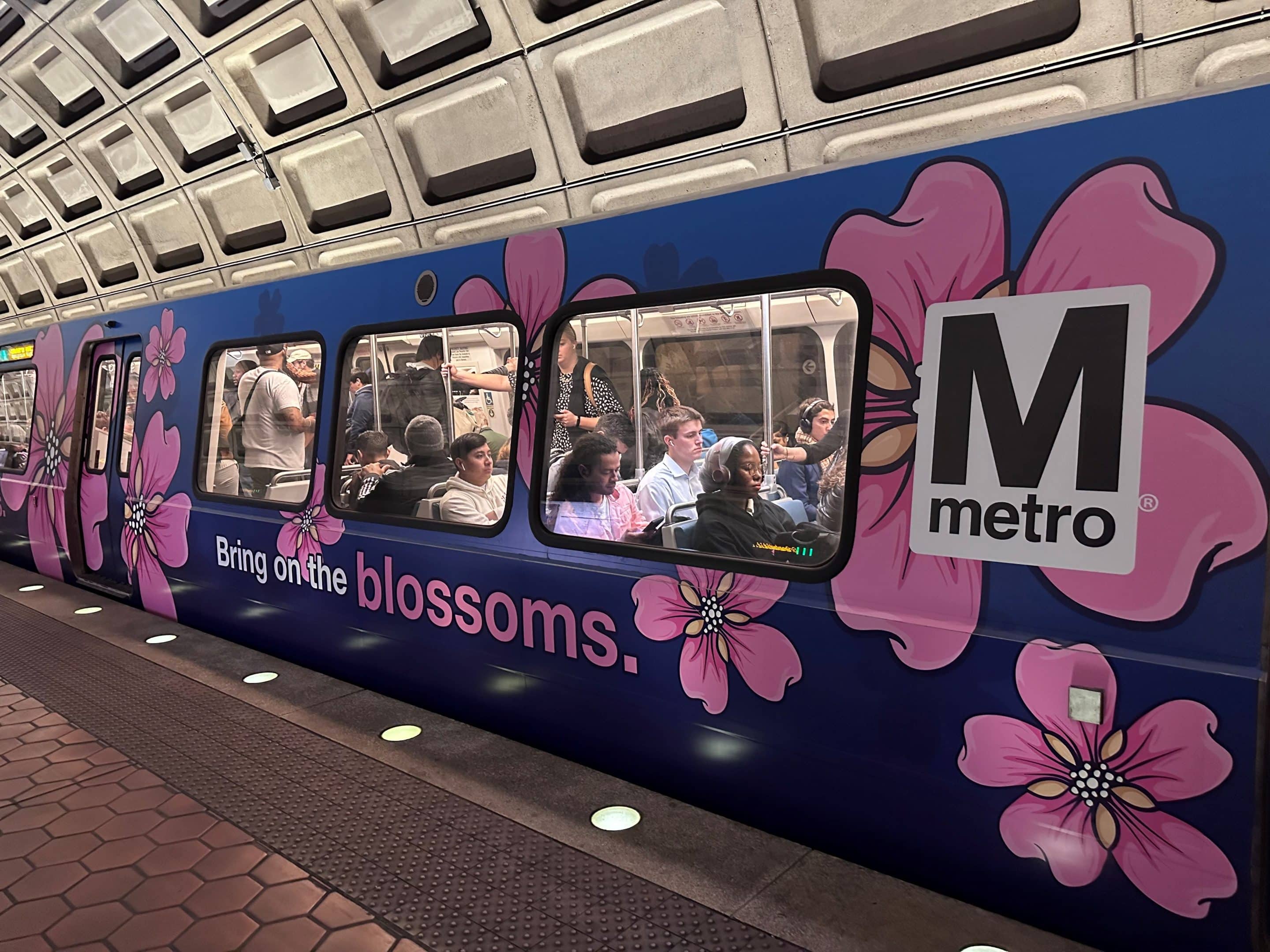
Metro trains featuring Cherry Blossoms throughout the season
The Challenge is Structural
Special events are different from rush hour in ways that matter to engineers. During a typical peak period, traffic builds gradually and resolves gradually. Demand is distributed across many origins and destinations. The system strains, but predictably so.
Large special events break that model. Demand spikes fast, concentrates in a tight geography, and disperses all at once. At the Cherry Blossom Festival, the Tidal Basin sits at the center of that concentration: one focal point, one parade route, one closest Metro station, and — critically — not enough parking to accommodate anywhere near the volume of visitors who try to drive. The result is somewhat predictable every year, yet it still catches people by surprise because the timing is up to Mother Nature. Highly variable spring weather patterns determine when peak bloom will occur, and if peak bloom falls on a glorious weather day, demand surges as everyone wants to experience the short-lived, fragile cherry blossoms.
The instinct to solve this with more infrastructure misses the point. A road network or parking supply sized for peak bloom Saturday would be completely oversized on every other day of the year, and a transportation system optimized for three days of festival traffic serves nobody well the other 362 days of the year. The real challenge is designing for the full range of conditions, then planning operations that can flex when the blossoms drop.
This pattern shows up across event types. A 2025 study in the Journal of Geovisualization and Spatial Analysis analyzed nearly 9.5 million e-scooter and e-bike trips in D.C. across 2023–2024 and found that large festivals and entertainment events generated ridership spikes four to seven times greater than would have been predicted by correlational analyses alone. The research confirmed what transportation engineers already know from practice: simple “before and after” comparisons underestimate how dramatically an event reshapes travel demand. Weather, gas prices, event duration, and built-environment factors all interact in ways that require more rigorous modeling to untangle.
The study also identified a relevant finding for anyone designing access strategies for large versus small events: the built environment matters far more for large events than for small ones. For big gatherings like parades and festivals, bike lane availability, sidewalk capacity, and proximity to transit stations are among the strongest predictors of how well people actually get to and from the venue. For smaller events, what matters most is simply whether the event is happening and how long it lasts. Infrastructure investment pays off at scale.
What Good Planning Looks Like
WMATA’s Cherry Blossom playbook is worth studying. The transit authority treats the festival as a multi-week operational event rather than a single-day surge. Metro suspends all major track work for the entire five-week festival period to ensure reliable service throughout. Extra trains are pre-staged throughout the system to add capacity on demand. Bus service is reinforced along key routes. Staffing increases at high-volume stations. And perhaps most practically: Metro advises riders to avoid Smithsonian Station at peak hours and use L’Enfant Plaza, Archives, or Federal Triangle instead. All are stations within reasonable walking distance that can absorb overflow without becoming choke points themselves.
That last point reflects a principle that applies well beyond transit: distributing demand intentionally is usually more effective than trying to absorb it at a single point. When a venue or event creates one obvious access point — one parking lot, one entry gate, one nearby transit stop — the system fails. When it creates several reasonable options with clear wayfinding, it performs.
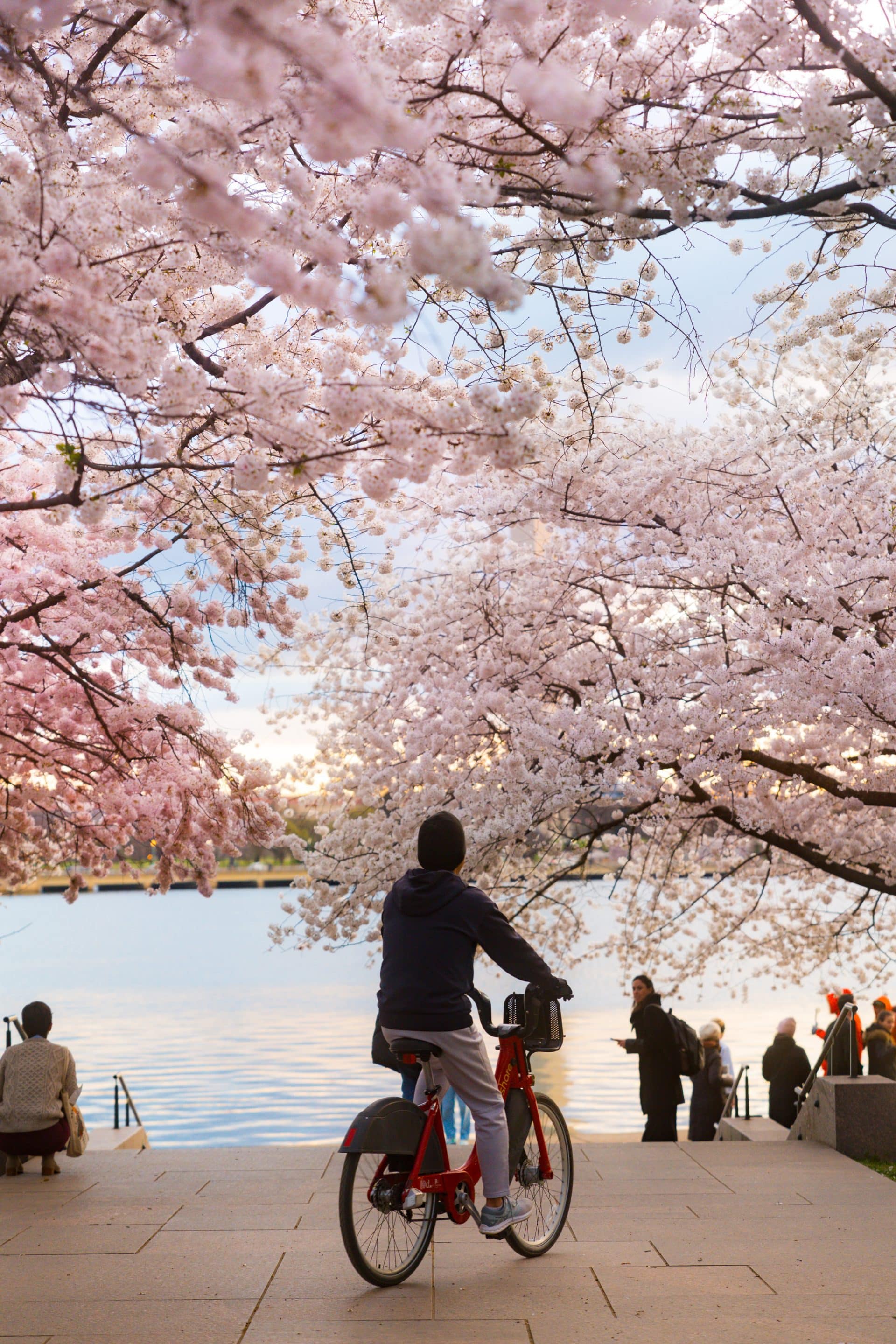
Active transportation is a popular way to get to the Tidal Basin during the festival
Pedestrian flow is part of this equation, too. Research on crowd simulation at major events shows that pedestrian walkway capacity often exceeds transit capacity by a factor of two or more during arrival, which is why arrivals tend to feel manageable while departures feel chaotic. The moment an event ends and thousands of people converge on the same exit paths, even well-designed infrastructure is tested. Post-event circulation (that is, where people go after they leave) deserves as much planning attention as the route they take to get there.
The Role of Engineering in the Event Planning Process
For venues, developers, and jurisdictions in the DMV, Cherry Blossom season is a useful annual reminder that transportation impact doesn’t stop at the parking lot entrance. The questions that matter are upstream: How many people can realistically arrive by transit, and how does that shape parking supply decisions? If street closures are required, where do displaced vehicles go, and who coordinates with adjacent property owners? What does the pedestrian connection between the nearest Metro station and the event look like, and is it adequate for peak conditions?
Those questions require transportation engineers at the table early, not after the site plan is set. At Gorove Slade, we work alongside developers and event organizers to answer them: analyzing trip generation, modeling access and circulation, coordinating with DDOT and other agencies, and designing site access that accounts for how people realistically move, not just how the baseline traffic model assumes they will. Our work at the Allianz Amphitheater at Riverfront and at FloydFest reflects exactly this kind of planning, thinking through how crowds arrive, how they leave, and what the surrounding network can realistically absorb before a single seat is sold.
The Cherry Blossom Festival draws a million and a half people because it is genuinely a spectacular experience. The transportation engineering behind it is what makes that possible without the whole city grinding to a halt. The same logic applies to amphitheaters, music festivals, sports complexes, and any development where the intensity of use exceeds what the surrounding network was designed to handle on its own.
Peak bloom is most beautiful when someone has done the planning.